


For more of Dante King’s writing, courses, and educational work, visit www.danteking.com. You can also follow Dante on Instagram @dantedkingofficial and TikTok @dantekingauthorofficial. Consider becoming a paid subscriber to support this work.
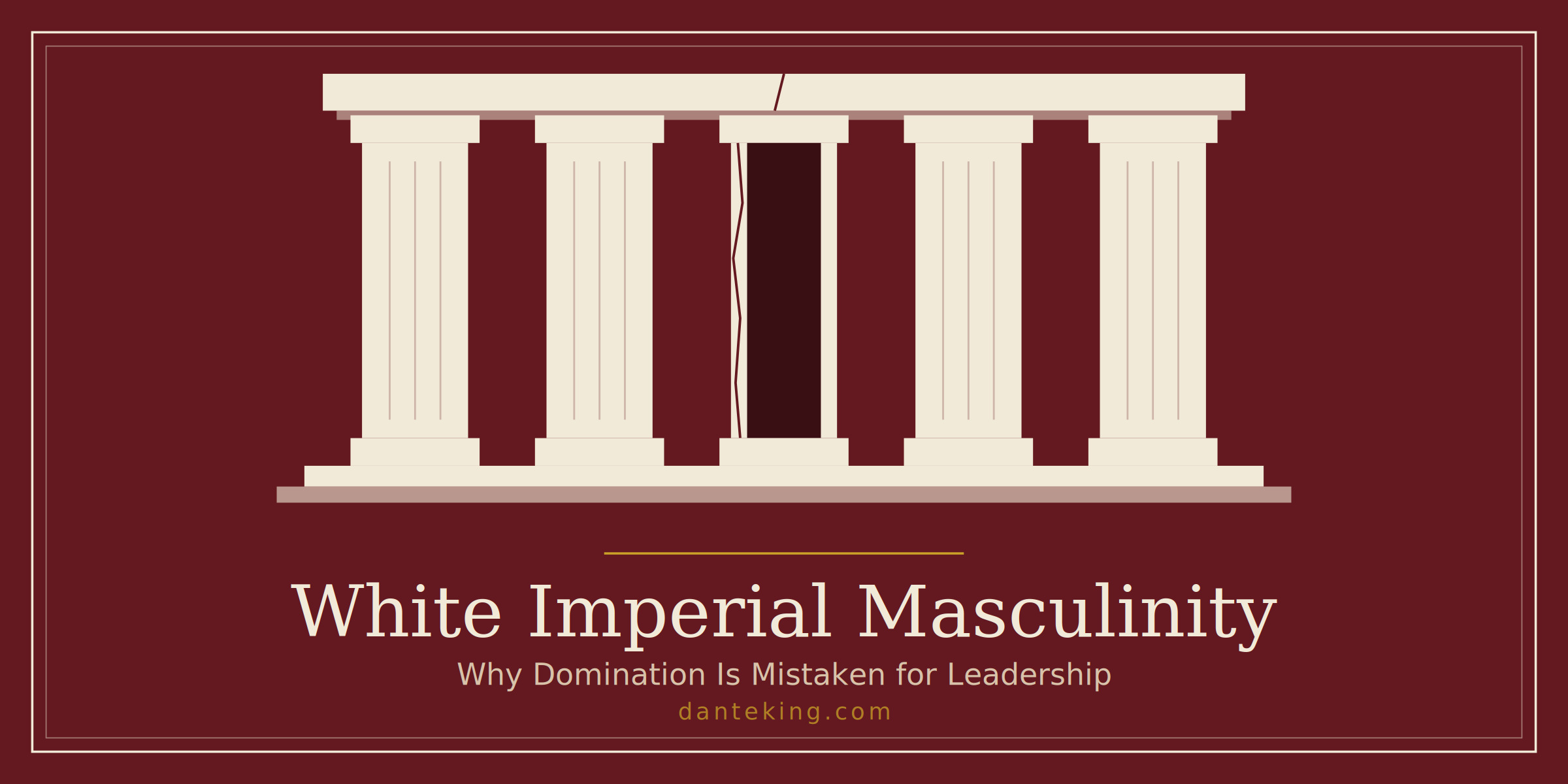
“The most dangerous societies are not those that merely possess power. They are those that become psychologically dependent upon demonstrating it.”
When Donald Trump threatened to destroy an Iranian bridge or power plant every time Iran attacked a ship in the Strait of Hormuz, many Americans interpreted his words as strength.
I heard something entirely different.
I heard fragility.
Not military strength.
Psychological fragility.
There is an important difference.
Throughout history, societies have often confused domination with leadership.
Force with wisdom.
Retaliation with courage.
Humiliation with victory.
Trump did not invent this confusion.
He inherited it.
The question is not why Donald Trump speaks this way.
The question is why millions of Americans hear that language and conclude that it reflects strong leadership.
That question cannot be answered by politics alone.
It requires psychology.
Strength or Compulsion?
One of the central questions that has occupied my scholarship is deceptively simple:
What happens when domination becomes a society’s primary definition of strength?
Healthy leadership possesses options.
It can negotiate.
It can listen.
It can compromise.
It can demonstrate restraint.
It can admit error.
It can distinguish between confidence and aggression.
Domination possesses only one language.
Escalation.
Every disagreement becomes a contest.
Every compromise becomes surrender.
Every criticism becomes disrespect.
Every limit becomes humiliation.
Every negotiation becomes a test of masculinity.
That is not confidence.
That is dependency.
Frantz Fanon Saw This Clearly
Frantz Fanon argued that colonialism was not sustained merely through military occupation.
It required a psychology.
The colonizer became psychologically dependent upon superiority.
The colonized became positioned as the permanent object through which that superiority could continually be demonstrated.
Violence therefore served two purposes.
It controlled the colonized.
It reassured the colonizer.
Every empire eventually develops this dependency.
The display of power becomes necessary not because it always achieves strategic objectives, but because it temporarily restores psychological certainty.
Domination becomes emotional regulation.
Dr. Frances Cress Welsing and the Compensatory System
Dr. Frances Cress Welsing described white supremacy as a compensatory behavioral system operating simultaneously through economics, education, entertainment, labor, law, politics, religion, sex, and war.
That word—
compensatory—
deserves careful attention.
Compensation occurs when someone attempts to overcome a perceived deficiency by emphasizing something else.
If an individual feels powerless, they may exaggerate dominance.
If they feel insecure, they may exaggerate certainty.
If they feel inadequate, they may exaggerate superiority.
Welsing argued that white supremacy functions similarly.
Power itself becomes compensatory.
Violence becomes compensatory.
Empire becomes compensatory.
War becomes compensatory.
This does not mean every white person consciously experiences those dynamics.
It means the system repeatedly rewards behaviors that reinforce them.
Trump’s and many of his supporters’ rhetoric fits this pattern remarkably well.
Every perceived insult demands overwhelming retaliation.
Every challenge requires public humiliation of an opponent.
Every disagreement becomes existential.
The objective is not resolution.
The objective is restoration of dominance.
Dr. Bobby Wright and the Psychopathic Racial Personality
Dr. Bobby Wright asked us to examine something many societies avoid asking.
What happens when violence ceases to produce moral conflict?
When domination no longer requires justification?
When cruelty becomes normalized?
Psychopathy is often misunderstood as emotional intensity.
It is often the opposite.
It is emotional absence.
The inability—or unwillingness—to experience empathy sufficient to interrupt harmful behavior.
This is not simply an individual phenomenon.
Institutions may also normalize emotional detachment.
Governments may.
Militaries may.
Corporations may.
Legal systems may.
The question becomes:
What kind of political culture repeatedly rewards leaders who threaten overwhelming violence while dismissing restraint as weakness?
Amos Wilson and the Manufacture of Strength
Dr. Amos Wilson reminded us that power does more than shape institutions.
Power shapes perception.
It teaches people what strength looks like.
What success looks like.
What leadership looks like.
What masculinity looks like.
This is perhaps one of white supremacy’s greatest achievements.
It convinces people that domination is maturity.
That conquest is competence.
That intimidation is confidence.
That retaliation is courage.
That fear equals respect.
Once those associations become culturally embedded, genuinely healthy leadership begins to appear weak.
Compassion appears naïve.
Reflection appears indecisive.
Diplomacy appears cowardly.
The culture begins rewarding precisely the personalities least equipped to govern.
The Colonial Definition of Manhood
Colonial America did not merely conquer land.
It constructed masculinity.
European boys learned that manhood meant ownership.
Ownership of land.
Ownership of labor.
Ownership of women.
Ownership of children.
Ownership of other human beings.
Ownership became identity.
Control became virtue.
Submission became the expected response from everyone beneath them.
This was not accidental.
It was educational.
Generation after generation learned that authority meant command rather than relationship.
The consequences remain with us.
Trump Is Familiar Because America Is Familiar
Donald Trump often appears extraordinary.
In some respects he is.
But psychologically, he is profoundly familiar.
He reflects assumptions embedded deeply within American political culture.
Strength requires dominance.
Winning requires humiliation.
Power requires spectators.
Leadership requires enemies.
Compromise signals weakness.
These assumptions long predate Donald Trump.
Andrew Jackson understood them.
Slaveholders understood them.
Indian fighters understood them.
Segregationists understood them.
Authoritarians always understand them.
Trump simply speaks them aloud.
Healthy Masculinity Is Different
Healthy masculinity does not fear negotiation.
It does not confuse listening with surrender.
It does not require constant demonstrations of power.
It protects without humiliating.
It leads without dominating.
It possesses enough internal security to tolerate disagreement.
Perhaps that is why genuinely secure leaders rarely need to announce their strength.
They demonstrate it through wisdom.
Through restraint.
Through accountability.
Through integrity.
Through courage.
Trump repeatedly demonstrates something else.
The inability to experience limitation without retaliation.
That is not power.
It is dependency masquerading as power.
The Most Dangerous Addiction
Empires rarely collapse because they lose the ability to wage war.
They collapse because they lose the ability to imagine anything besides war.
Violence becomes habitual.
Domination becomes identity.
Retaliation becomes governance.
Eventually every problem begins to resemble a military problem because the society has forgotten how to exercise any other kind of power.
That may be where America finds itself today.
Not because Donald Trump created this condition.
Because he reflects it.
He has become the psychological mirror of a nation that still struggles to distinguish domination from leadership.
Until that distinction becomes clear, America will continue mistaking aggression for confidence.
It will continue rewarding leaders whose emotional need to appear powerful exceeds their capacity to govern wisely.
And perhaps that is the most dangerous pathology of all.
Because the greatest threat to a civilization is not the enemy standing outside its borders.
It is the psychological architecture governing those who command it from within.

To learn more about Dante King’s books, educational resources, online video courses, and upcoming events, please visit:
www.danteking.com
You can also follow Dante’s work and commentary on social media:
Instagram: @dantedkingofficial
TikTok: @dantekingauthorofficial
If this article resonated with you, please consider becoming a paid subscriber. Your support helps sustain the research, writing, and educational work dedicated to examining the historical and psychological foundations of anti-Blackness, racism, and white supremacy in American culture and institutions.
Paid subscribers make it possible to continue producing in-depth analysis, public scholarship, and educational content that challenges dominant narratives and advances a deeper understanding of our collective history.
Thank you for reading, engaging, and supporting this work.