

The God in the Mirror
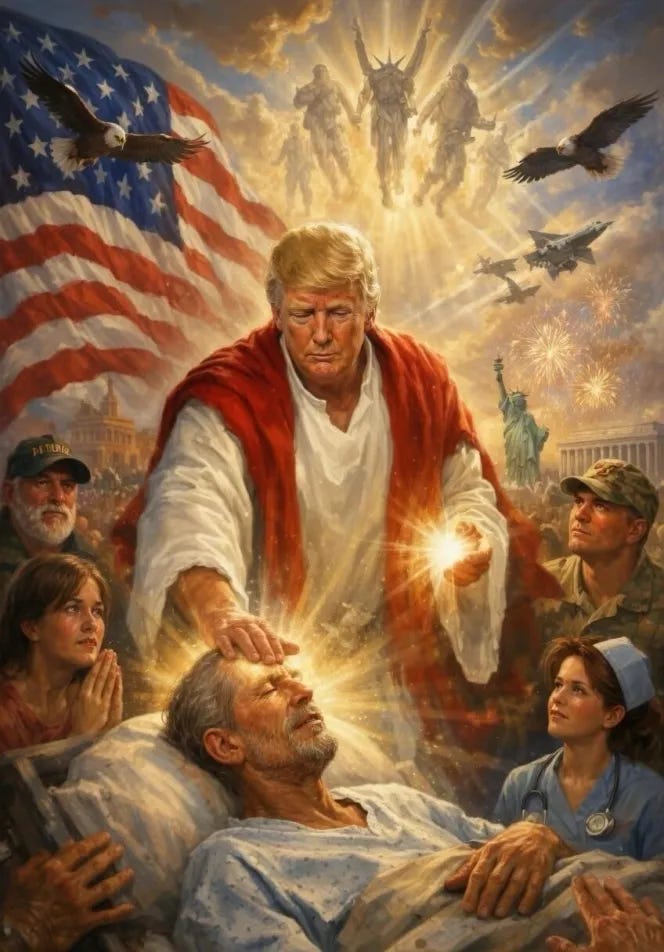
On Orthodox Easter, the President of the United States posted an AI-generated image of himself dressed as Jesus Christ. White robe. Hands glowing. Healing the sick while eagles and fighter jets filled

I want to begin not with the image but with the instinct behind it.
A man waging war on Iran posts himself healing the sick. A man who five days earlier threatened to destroy “a whole civilization” shares an image of himself as the Prince of Peace. A man whose own adviser compared him to the crucified Christ at an Easter luncheon — and who responded by saying “They call me king now. Can you believe it?” — that man, on the holiest night of the Orthodox calendar, looked at a picture of himself dressed as God and posted it without comment.
The public debate has centered on whether this was offensive. Whether it was blasphemous. Whether it was politically foolish.
That is the wrong debate.
The question is not whether the image offended Christians. The question is what kind of mind produces it — and what that mind reveals about the system that elevated it.
What the Congregation Saw
The backlash did not come from Democrats. It did not come from cable news panels or editorial boards. It came from the altar.
Marjorie Taylor Greene wrote on X: “On Orthodox Easter, President Trump attacked the Pope because the Pope is rightly against Trump’s war in Iran and then he posted this picture of himself as if he is replacing Jesus. This comes after last week’s post of his evil tirade on Easter and then threatening to kill an entire civilization.” She followed it with: “It’s more than blasphemy. It’s an Antichrist spirit.”
Megan Basham, a conservative Christian commentator, called it “OUTRAGEOUS blasphemy” and demanded Trump ask God for forgiveness. Isabel Brown, a Catholic Daily Wire podcaster allied with the Trump White House, called the post “disgusting and unacceptable.” Riley Gaines said she could not understand why he would post it. Milo Yiannopoulos wrote: “We tolerated this kind of meme against our better judgment because he promised to save America and only when it was clear he didn’t actually think he was the Messiah.”
Read that last sentence again. It tells you everything.
The congregation tolerated the iconography because they believed it was performance. They are discovering it is conviction.
Allie Beth Stuckey, another conservative Christian commentator, offered the most surgically precise observation of the day: “That image is what happens when Paula White is your personal pastor and people around you are continually comparing you to Christ.”
She is naming the feedback loop. And the feedback loop is the pathology.
The Feedback Loop
In The Psychopathy of Whiteness, I define White Malignant Narcissism as an extreme personality configuration combining grandiosity, sadism, and paranoia. It underpins the emotional structure of white supremacy. It is the psychic machinery that transforms insecurity into domination.
But malignant narcissism does not sustain itself alone. It requires a congregation — a validating chorus that mirrors the narcissist’s self-image back to him until he can no longer distinguish between worship and reality.
This is exactly what Stuckey described. And the timeline proves it.
At the White House Easter luncheon this month, Trump’s spiritual adviser Paula White told him: “No one has paid the price like you have paid the price. It almost cost you your life. You were betrayed, and arrested, and falsely accused.” Then she drew the resurrection into the comparison: “Because of His resurrection, you rose up. Because He was victorious, you were victorious.”
Trump did not push back. He escalated. “On Palm Sunday, Jesus entered Jerusalem as crowds welcomed him with praise, honoring him as king,” he said. “They call me king now. Can you believe it?”
He then compared his legal battles to the arrest of Christ: “He was really betrayed. We know the feeling.”
The White House posted the footage. Then deleted it.
Last year, following the death of Pope Francis, Trump shared an image of himself as the Pope.
In 2019, standing on the White House lawn during a trade dispute, he looked up at the sky and said: “I am the chosen one.”
Each time, the congregation absorbed it. Each time, the boundary between metaphor and belief eroded further. Each time, the narcissist tested whether the chorus would hold.
On Sunday night, it broke.
The Four Defenses
At Monday’s press conference, Trump was asked about the image. His response was a clinical demonstration of the psycho-cognitive defense mechanisms I have spent two books documenting.
He said: “I did post it, and I thought it was me as a doctor and had to do with Red Cross.”
This is Denial. The image depicts a figure in a white robe and red sash, hands radiating divine light, healing a man while soldiers ascend toward heaven. Calling this a “doctor” is not a misreading. It is the refusal to acknowledge what is plainly visible — sustained through delusion, reinforced by the expectation that no one will challenge the reinterpretation.
He then said: “Only the fake news could come up with that one.”
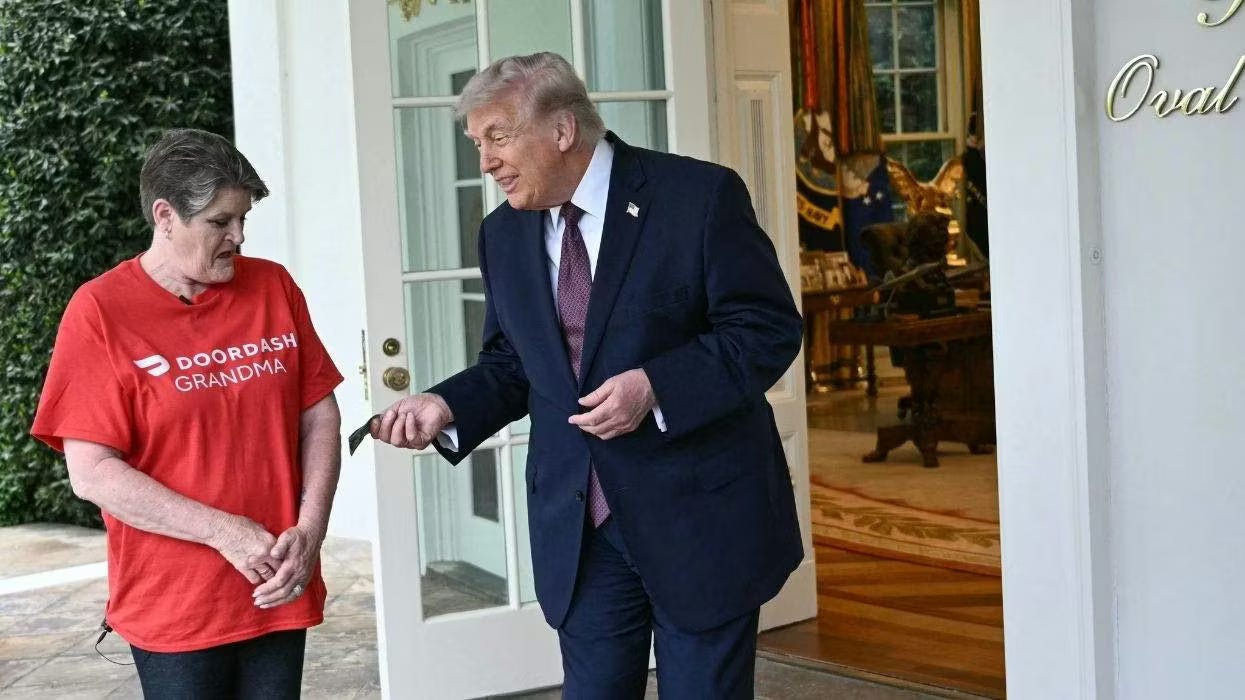
This is Defensiveness — emotional resistance expressed as hostility toward anyone who names the reality the subject cannot tolerate.
By reframing the image as a medical scene rather than a messianic one, Trump relocated the controversy from his own grandiosity to the media’s interpretation. This is Deflection — the strategic redirection away from accountability. The classic maneuver of the personality-disordered: you are the problem for seeing what I showed you.
And beneath it all: the psychic detachment that allows a man to post an image of himself as God on the holiest night of the Orthodox calendar, minutes after attacking the Pope, and then claim — apparently without irony — that he did not understand its content. This is Dissociation. The gap between action and awareness where the disorder lives.
Denial. Defensiveness. Deflection. Dissociation.
Four mechanisms. One image. The entire architecture of whiteness performing in real time.
The Oldest Heresy
None of this is new. What happened on Sunday night is six centuries old.
In 1452, Pope Nicholas V issued the papal bull Dum Diversas, granting European monarchs permission to “invade, search out, capture, vanquish, and subdue all Saracens and pagans whatsoever... and to reduce their persons to perpetual slavery.” In 1493, Inter Caetera divided the non-Christian world between Spain and Portugal — theology as real estate, God as notary.
The Church did not merely bless conquest. It became conquest’s justification. The cross and the sword merged. The altar and the throne became indistinguishable. And over centuries, the object of worship shifted. The faith stopped being about God. It became about the faithful — their power, their purity, their divine right to rule.
Pastor Benjamin Boswell, at the 2025 Global Antiracism Summit, named this transformation precisely: “What began as Christian supremacy mutated into European supremacy, then Anglo-Saxon supremacy, and eventually White supremacy. Whether they are aware of it or not, most European Christians are not worshipping God or Jesus, but whiteness.”
This is the psycho-theological heart of what I diagnose in my work. Domination confused with salvation. Cruelty mistaken for righteousness. The self divinized. The other demonized. And power — always power — rebranded as virtue.
Trump did not invent this. He inherited it. But he is the first president to make the subtext literal — to post the image that the ideology has always carried in its bones. The man on the altar has always believed he was God. Sunday night, he simply said so.
The Savior Who Destroys
There is a thread connecting April 7 to April 12 that most commentators have missed.
On April 7, Trump threatened Iran: “A whole civilization will die tonight.” On April 12, he posted himself as Christ — healing, radiant, surrounded by the machinery of war recast as instruments of salvation.
The destroyer and the savior are the same man. And in the logic of this pathology, they must be. The one who commands the annihilation of a civilization must also be the one anointed to heal the world. The same hand that signs the order for war reaches out to touch the sick man’s forehead. The robe of the messiah and the authority of the commander-in-chief are, in this image, the same garment.
This is not hypocrisy. Hypocrisy requires awareness of contradiction. This is something clinical — the inability to distinguish between destruction and deliverance, between dominion and divinity. It is the terminal stage of a pathology I describe in my book as Malignant Diabolical Psychopathy: the fusion of state power with evangelical theology to consecrate cruelty. It is not a new phenomenon. It is colonial Christianity returning home.
What Breaks Next
The evangelical fracture is the real story. Everything else is noise.
For years, Trump’s religious base has been the most durable pillar of his coalition. They tolerated the Access Hollywood tape. They tolerated the Stormy Daniels settlement. They tolerated the E. Jean Carroll verdict. They tolerated “I am the chosen one.” They tolerated the Trump Bible. They tolerated Paula White’s Easter sermon. They tolerated the image of himself as Pope.
Each of these was a test. The narcissist is always testing whether the congregation will hold — whether the chorus will continue to mirror his self-image back to him without flinching. Each time the congregation absorbs the escalation, the narcissist receives confirmation that the delusion is shared. Each absorption raises the threshold for the next test.
Sunday night, the threshold was crossed. Not because the image was worse than what came before — it is arguably no more grandiose than “I am the chosen one” or “They call me king.” But because the narcissist, for the first time, produced the image himself. The congregation had been the ones creating the iconography. They made the flags, the murals, the memes comparing him to Christ. That was their offering. When the narcissist creates his own icon and places himself on the altar — when he no longer needs the congregation to perform the deification because he has internalized it completely — the relationship inverts. He is no longer their instrument. They are his.
That is why Greene’s language matters. “Antichrist spirit” is not political commentary. It is a theological alarm. She is saying: the man we elevated has become the thing our faith warns us about. Whether she fully grasps the clinical implications of that recognition is secondary. The recognition itself is the fracture.
The question now is whether the fracture holds — whether the congregation reassembles around the idol, as it has so many times before, or whether this is the narcissistic collapse that cannot be papered over.
I do not make predictions. I make diagnoses.
And the diagnosis is this: the patient has stopped performing health. The delusion that was once managed — contained within winks, jokes, and plausible deniability — is now the governing reality. The man who once let others call him the chosen one now generates his own divine imagery and posts it on the holiest night of the Christian calendar.
The empire is not collapsing because of external enemies. It is collapsing because of internal rot — because its gods were mirrors all along. And on Sunday night, the mirror was posted to Truth Social for the entire world to see.
———
Dante King is the author of The Psychopathy of Whiteness: The Epigenetics of Anti-Blackness, Malignant Narcissism, and Collective Antisocial Personality Disorder and Diagnosing Whiteness and Anti-Blackness: White Psychopathology, Collective Psychosis, and Trauma in America. He is an organizational consultant, legal expert witness, and adjunct professor of medicine who has trained institutions including Mayo Clinic, Stanford Medicine, Johns Hopkins, and UCSF. He is the founder of Blackademics, a 501(c)(3) nonprofit dedicated to racial justice education.
Subscribe to receive the full diagnosis.