

The Counter-Revolution Continues
Alabama, the Supreme Court, and the Psychodynamics of White Political Power

For more of Dante King’s writing, courses, and educational work, visit www.danteking.com. You can also follow Dante on Instagram @dantedkingofficial and TikTok @dantekingauthorofficial. Consider becoming a paid subscriber to support this work.
The Alabama ruling is not an anomaly.
It is not judicial conservatism.
It is not textualism.
It is not originalism.
It is not constitutional fidelity.
It is the latest chapter in a 150-year pattern wherein the United States Supreme Court has repeatedly reinterpreted the Constitution whenever Black political advancement threatened the racial hierarchy upon which the American republic was built.
From Slaughter-House (1873) to United States v. Cruikshank (1876), from the Civil Rights Cases (1883) to Plessy v. Ferguson (1896), from Milliken v. Bradley (1974) to Shelby County v. Holder (2013), and now Alabama’s congressional map cases, the Court has consistently narrowed constitutional protections for Black Americans while expanding protections for those seeking to preserve white political power.
The question is not whether this pattern exists.
The question is why.
The Court’s Favorite Fiction: Race No Longer Matters
One of the most remarkable features of American jurisprudence is its insistence that race can be ignored after race has already structured the entire political landscape.
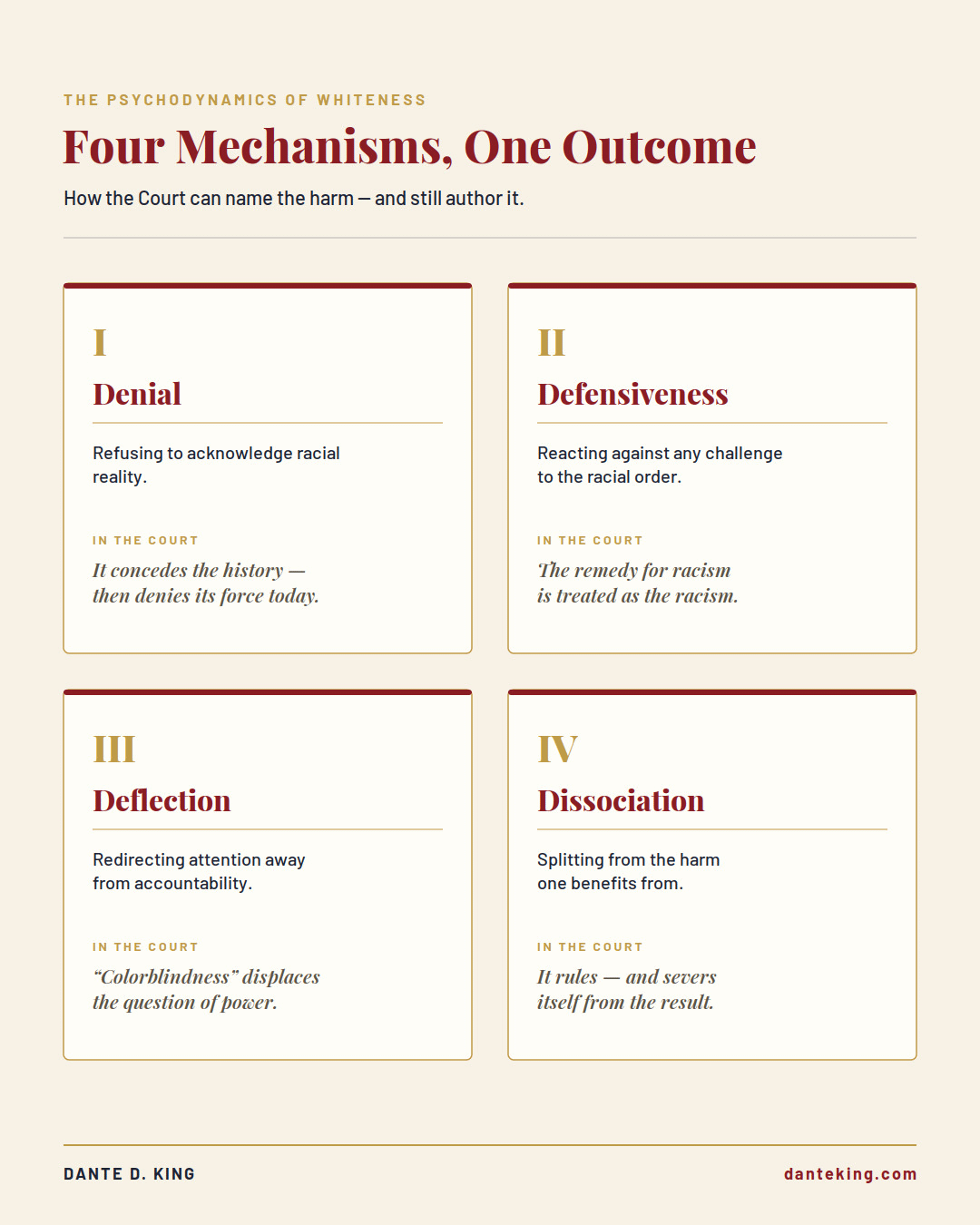
This is one of the central psycho-cognitive defense mechanisms discussed in The Psychopathy of Whiteness.
Specifically:
Denial
The refusal to acknowledge racial reality through revisionism, avoidance, and historical distortion.
The Court repeatedly performs this function.
It acknowledges centuries of racial exclusion.
Then insists that race-conscious remedies themselves constitute discrimination.
This is not neutrality.
It is denial masquerading as constitutional principle.

Slaughter-House: The Original Betrayal
The Fourteenth Amendment was ratified in 1868 for a clear purpose.
To protect formerly enslaved Black Americans from white political retaliation.
Yet only five years later, in the Slaughter-House Cases (1873), the Supreme Court dramatically narrowed the amendment’s reach.
The Court effectively stripped the Privileges and Immunities Clause of meaningful force.
The amendment designed to protect Black freedom became a shell of itself.
The counter-revolution had begun.
Cruikshank and the Legalization of White Terror
Three years later, in United States v. Cruikshank (1876), the Court overturned federal prosecutions stemming from the Colfax Massacre.
More than one hundred Black citizens had been murdered for attempting to exercise political power.
The Court’s response?
To limit federal authority to protect them.
The message was unmistakable:
Black citizenship would exist in theory.
White terror would govern in practice.
The Psychodynamics Behind the Law
Dr. Frances Cress Welsing argued that racism operates as a total system of perception, thought, emotion, law, politics, and behavior organized around maintaining white dominance.
Importantly, Welsing did not define white supremacy merely as prejudice.
She defined it as a comprehensive power system operating simultaneously through:
economics
education
entertainment
labor
law
politics
religion
sex
war
The Supreme Court is one of those institutions.
The Court is not outside the system.
The Court is one of the system’s most important enforcement mechanisms.
Fanon’s Warning
Frantz Fanon wrote:
“The settler makes history and is conscious of making it.”
Fanon observed that colonial systems continuously reinvent themselves while insisting they have changed.
The language changes.
The objectives remain.
The rhetoric evolves.
The hierarchy survives.
What Alabama demonstrates is not the disappearance of racial domination.
It demonstrates its adaptation.
Bobby Wright and the Psychopathic Racial Personality
Dr. Bobby Wright argued that the defining feature of psychopathy is not violence alone.
It is the capacity to inflict harm while feeling morally justified in doing so.
That insight helps explain modern voting rights jurisprudence.
The Court can:
acknowledge racial discrimination;
acknowledge racial exclusion;
acknowledge centuries of disenfranchisement;
and still conclude that protecting Black voting power is unconstitutional.
This is not simply legal reasoning.
It is moral dissociation.
The Psycho-Cognitive Defense Mechanisms of Whiteness
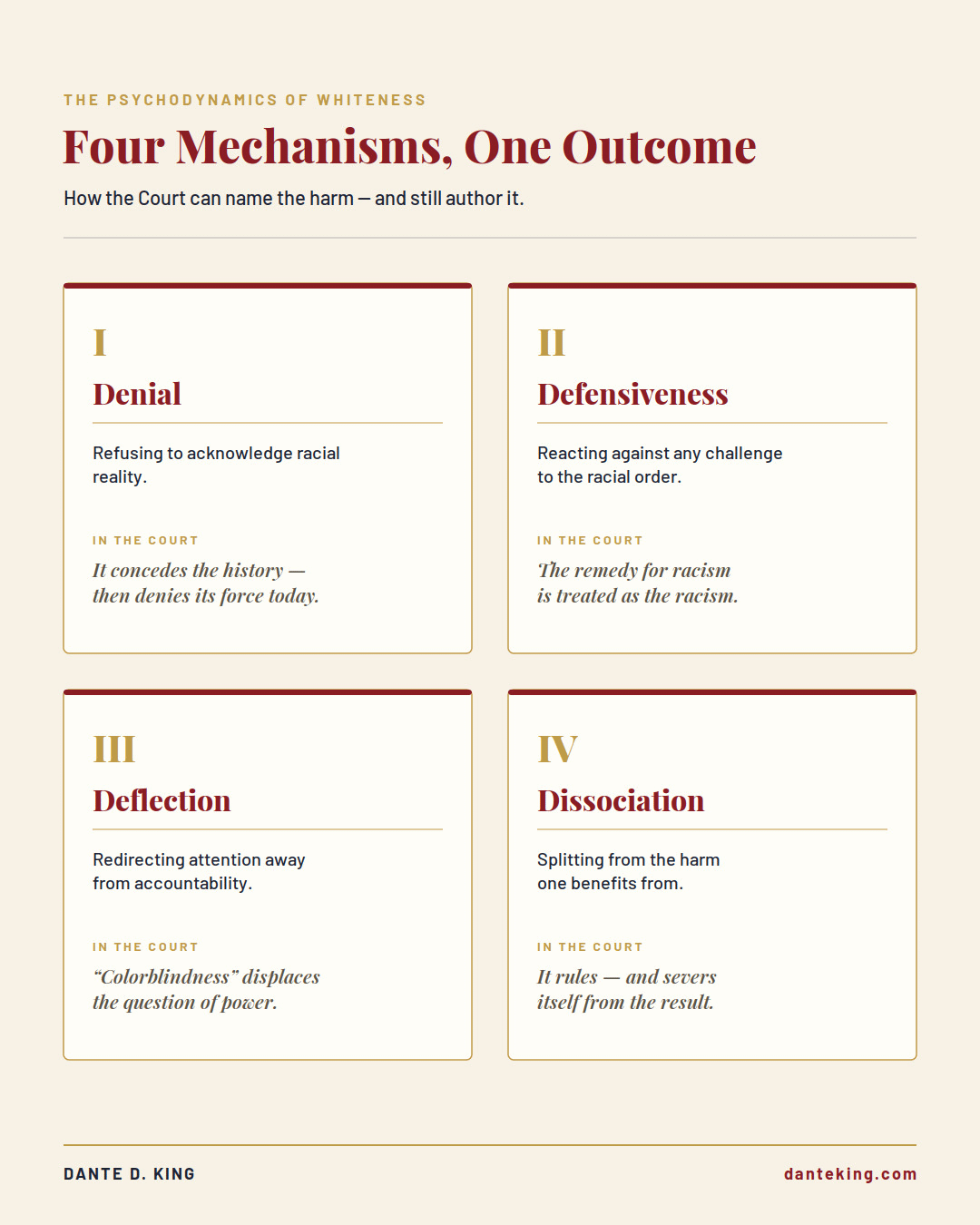
In The Psychopathy of Whiteness, I describe four recurring defense mechanisms:
Denial
Refusing to acknowledge racial reality.
Defensiveness
Reacting negatively when racial systems are challenged.
Deflection
Redirecting attention away from accountability.
Dissociation
Separating oneself psychologically from the harms one benefits from.
Every one of these mechanisms appears in contemporary voting-rights jurisprudence.
The Court denies the continuing impact of racial exclusion.
It becomes defensive toward race-conscious remedies.
It deflects attention toward abstract concepts like “colorblindness.”
It dissociates itself from the consequences of its rulings.
Alabama Is Not the Story
The Court Is
Alabama merely did what Alabama has always done.
The remarkable fact is not that Alabama sought to diminish Black political power.
The remarkable fact is that the Supreme Court rewarded it.
Again.
Just as it rewarded:
Louisiana in Plessy
Mississippi after Reconstruction
Southern school districts after Brown
Shelby County in 2013
The institution keeps changing its constitutional theories.
The outcome remains remarkably consistent.
Reconstruction Is Still Being Overthrown
The struggle that began after the Civil War never ended.
It merely changed form.
The weapons evolved:
literacy tests
poll taxes
white primaries
racial gerrymanders
“colorblind” jurisprudence
Different language.
Same objective.
The Supreme Court’s Alabama ruling should not be understood as an isolated legal decision.
It should be understood as the latest chapter in America’s longest-running constitutional project:
the preservation of white political power through the appearance of legal neutrality.
That is the deeper story.
And until we are willing to confront the psychodynamics that animate these decisions—the denial, defensiveness, deflection, dissociation, racial fear, and institutional self-deception that scholars from Fanon to Welsing to Wright identified decades ago—we will continue mistaking counter-revolution for constitutional law.
The Court is not simply interpreting history.
It is helping to reproduce it.
To learn more about Dante King’s books, educational resources, online video courses, and upcoming events, please visit:
www.danteking.com
You can also follow Dante’s work and commentary on social media:
Instagram: @dantedkingofficial
TikTok: @dantekingauthorofficial
If this article resonated with you, please consider becoming a paid subscriber. Your support helps sustain the research, writing, and educational work dedicated to examining the historical and psychological foundations of anti-Blackness, racism, and white supremacy in American culture and institutions.
Paid subscribers make it possible to continue producing in-depth analysis, public scholarship, and educational content that challenges dominant narratives and advances a deeper understanding of our collective history.
Thank you for reading, engaging, and supporting this work.
So well explained, on point, and concise as all ways.